
Fort Worth Resident Lookup Records
Different Fort Worth records answer different identity questions. The right starting point depends on the known fact. A parcel result can link an assessed owner to a situs and mailing address. A court index can identify a case and party role. A vital index can identify a possible event year and county. None should be stretched into proof of an unstated fact. Keep the system identifier, date searched, and custodian with every useful result.
| Record | Confirms | Where | Access |
|---|---|---|---|
| Appraisal record | Assessed owner, situs, mailing address, parcel | Tarrant Appraisal District | Free; ownership assessment is not occupancy |
| Recorded instrument | Grantor, grantee, instrument, legal description | Tarrant County Official Records Search | Index and image access vary; historic conversion continues |
| Voter confirmation | Status, address, precinct, districts | Tarrant County Voter Lookup | Free lookup with protected-field limits |
| Court docket | Party, case number, filings, events, disposition | Odyssey, District Clerk, Municipal Court, or re:SearchTX | Access differs by court and record status |
| Vital index or certificate | Event details, parents, spouse, or death information | Texas DSHS and local registrar | Index is not a certificate; confidentiality and eligibility apply |
| Business or license filing | Entity affiliation or professional status | SOSDirect and agency boards | Account, search, copy, and redaction rules vary |
For a historical address, a directory, census record, obituary, or county archive may offer the first date anchor. For a current record question, begin with the responsible county or state custodian. A record that uses a Fort Worth mailing address can still refer to another jurisdiction or a past date, so read the City field, record date, and role before joining it to a person.
Fort Worth Resident Lookup Anchors
Require two or three independent anchors before combining Fort Worth records. Good anchors include a time-bounded address, an age or event date, a spouse, parent, occupation or business, and a system identifier such as a parcel account, instrument number, case number, State Voter ID, or license number. A person in a 1914 directory should not be merged with a 1912 deed grantee of the same name solely because both entries say Fort Worth.
Record initials, married names, middle names, spelling changes, and alternate street numbers as separate notes. The local property roll distinguishes the physical situs address from the owner's primary mailing address. That mailing field can be useful for a record trail, but it does not prove the owner was living at the property. The same care applies to a voter card, court party entry, or business filing.
Fort Worth Resident Lookup Court Checks
Use the court that keeps the case. Tarrant County Odyssey Public Access is the entry point for County Courts at Law, Probate, and Justice Courts. District civil, family, felony, and juvenile material belongs with the District Clerk. The statewide Texas re:SearchTX layer can help identify participating district or county case data, but court coverage and document access vary. The official record remains with the court that maintains it.
| Portal field | Verification use |
|---|---|
| Party name | Try surname, given name, initials, spelling variants, and organization names where the portal permits. |
| Case number | The most precise route when known. Match the format and punctuation required by the court system. |
| Court or case type | Use the available county, probate, civil, criminal, or other filters to avoid mixing court systems. |
| Filing or date range | Apply a range when the live portal exposes it, then preserve the court and retrieval date. |
The Texas re:SearchTX entry page is the statewide starting point captured for court research.
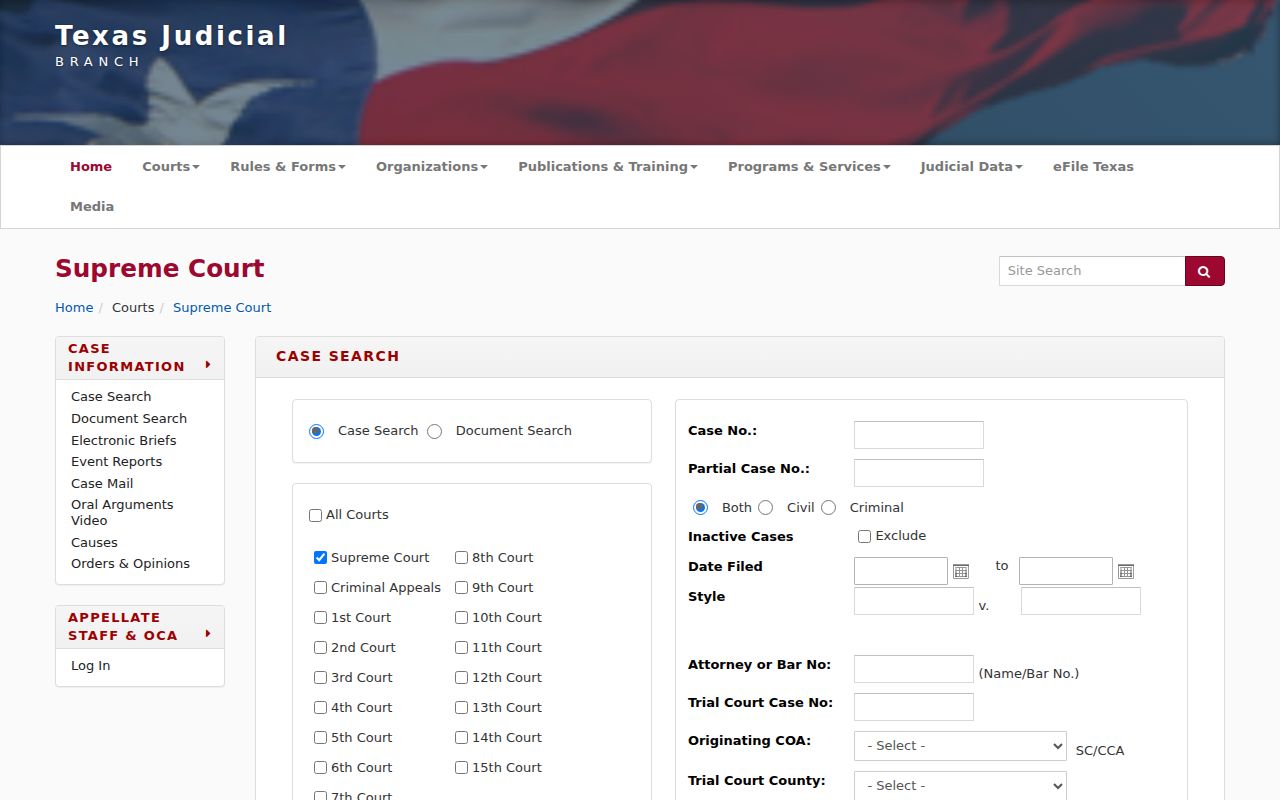
The screen establishes a search route, not that a named person has a case or lives in Fort Worth.
Tarrant's County Clerk says its Class A and B misdemeanor records reach back to 1976, while felony district records belong with the District Clerk. The District Clerk offers free self-service terminals onsite, and its published basic clerk search is $5. Paper copies are listed at $1 per page; electronic copies are $1 for 1-10 pages and $0.10 per page above ten; certification adds $5. Its published remote account is $120 to begin and $35 per month, a separate access route from the free terminal. Juvenile, sealed, expunged, adoption, and other restricted files may be absent or redacted.
Fort Worth Docket Result Details
A docket is the court's running list of case events. It is not necessarily a complete set of pleadings or proof that every indexed party is the person sought. No live Odyssey case was retrieved during the research, so current dynamic control labels, no-match wording, and a local result card remain unconfirmed. When a public result is available, capture the fields the court actually displays.
- Case number, court or court type, caption, and each party's displayed role.
- Filing date, case or offense category, current status, hearing details, and judicial officer if shown.
- Register-of-actions events, attorney or bondsman fields when exposed, and any docket updates.
- Document title, file date, image or download availability, redaction notice, disposition, and judgment or order date.
Use a case number and date when requesting an existing docket sheet, judgment, named filing, or case file. Courts may use their own procedures even where the Texas Public Information Act also supplies a general access route.
Fort Worth Resident Lookup Vital Indexes
Texas DSHS birth and death indexes are useful event leads. The digital birth index begins in 1925 and the death index begins in 1965, while microfiche and verification resources reach back to 1903. An index can identify enough date, place, and family detail to decide what to request. It is not the certificate itself, and it does not replace the local registrar's eligibility review.
The DSHS index page shows the statewide source used to narrow a Fort Worth event before contacting the correct custodian.
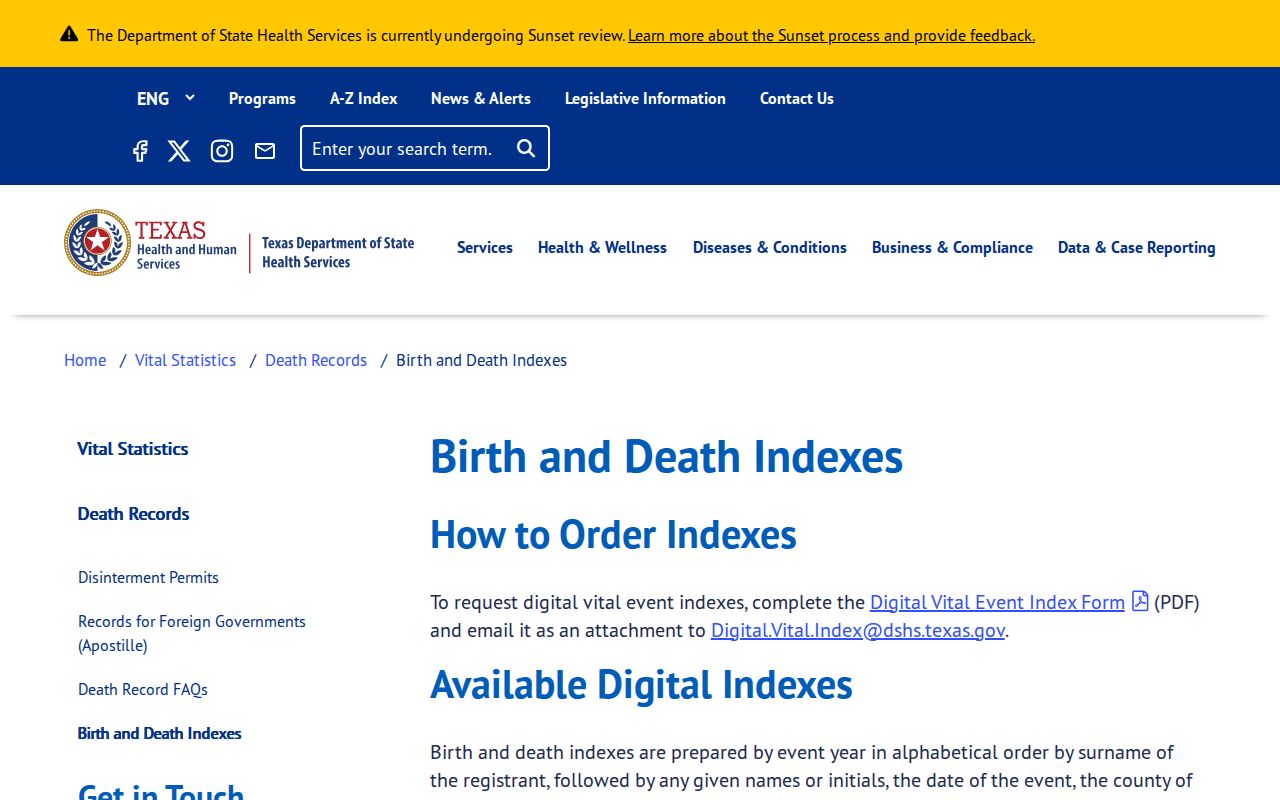
The separate certificate process is important because a state index and a certified record answer different questions.
Tarrant birth records are confidential for 75 years and death records for 25 years under Texas Government Code §552.115. Tarrant's application describes in-person, mail, and VitalChek routes, with identification, sworn-statement, relationship, and payment requirements. Tarrant is not the local registrar for Arlington births or deaths after 1971 or Grapevine births or deaths after 1973. A marriage or divorce index may identify a case, while a public decree is obtained through the District Clerk.
Fort Worth Resident Lookup State Records
Some state systems help separate a same-name result but should be used narrowly. The Texas Department of Criminal Justice search accepts last name, first name, TDCJ number, or SID, and may provide a location, offenses, and projected-release information. A result is a statutory custody record, not a current-residence confirmation. Use the displayed identification number, date of birth where lawfully available, and conviction county before attributing it to a person.
The official TDCJ search screen is a state-custody lead only when a specific, lawful records question requires that system.
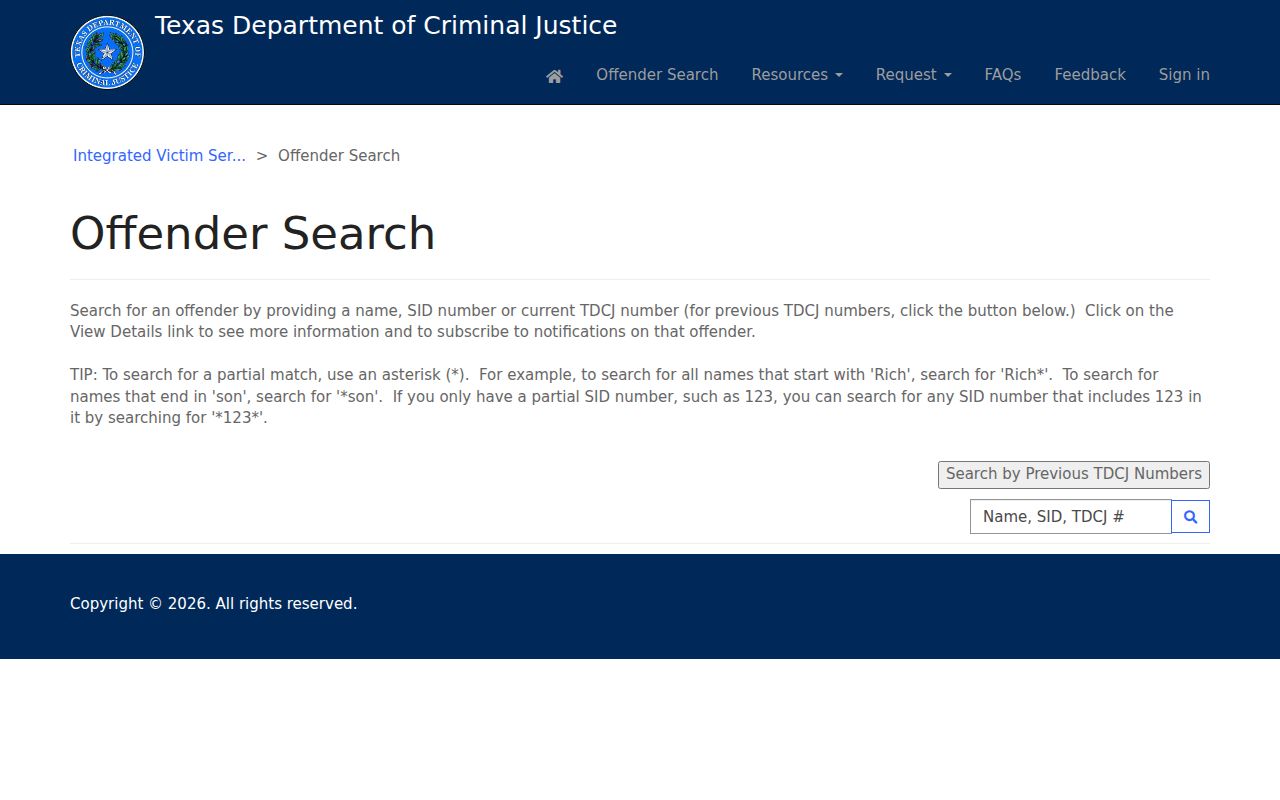
Its name, SID, and TDCJ-number options show why a bare name match is not enough.
For business identity, SOSDirect lists entity, filing, registered-agent, officer or manager, and document information where public. A filing may show a registered office rather than a person's residence. For an adoption or birth-parent question, Texas requires the Central Adoption Registry, a court order, or an authorized agency route. A public index is not a substitute for that formal process.
Verifying Fort Worth Resident Records
Use the record chain in order. A primary record identifier is stronger than a matching surname, and a historical fact should remain tied to the date it was recorded. A directory entry can support “listed at this address in 1914.” It cannot by itself support “lives there now.” For old Fort Worth addresses, the historical directory shelf is available through the Fort Worth city directory collections.
- Start with a name plus a time-bounded address, age, spouse, parent, occupation, or other independent anchor.
- Use TAD or Official Records to preserve an account, instrument, situs, legal description, grantor, or grantee as applicable.
- Check the appropriate court index by case number or name variants, then compare court, dates, party role, and displayed events.
- Use a DSHS index or local certificate route for an event lead, respecting confidentiality and eligibility rules.
- Keep the source URL, retrieval date, page, and unresolved conflicts rather than forcing a match.
- Docket
- A court's chronological case-event record. It may list filings and hearings without supplying every document image.
- Index and image
- An index is a finding aid that identifies a record. An image is a reproduction of the underlying page when the custodian makes it available.
- Certified copy
- A copy issued and certified by the custodian. It can carry identity, relationship, fee, and access requirements that an index does not.
Fort Worth Resident Lookup Requests
When an official online search ends, ask the correct custodian for an existing record. Tarrant County accepts Public Information Act requests by email, mail, fax, in person, and its online route. A usable request names the existing record, department, date range, address, case number, or other locator. It does not need a reason, but it cannot require staff to create a new personal dossier or disclose a protected field.
Texas Government Code Chapter 552 requires prompt production. If a body cannot produce the material within ten business days, it must give written notice of a reasonable availability date. Cost estimates may apply to larger or data-manipulation requests. The request does not override a court seal, juvenile restriction, vital-record confidentiality period, or protected voter address. Note: retain the request and response because they identify precisely what the custodian searched.
Election geography changes, too. Tarrant Elections announced a Voter Precinct Change Lookup effective January 1, 2026. Its Ballot Verifier describes ballot-image and cast-vote-record data from March 5, 2024 forward because of technology limits. Save the lookup date, election version, and source URL rather than treating a current precinct display as a historical record.
Limits on Fort Worth Resident Lookup
Texas Election Code §13.004 restricts specified voter information, including phone numbers, driver-license or DPS ID information, and protected residential-address categories. Address Confidentiality Program participants and certain protected officials may use suppressed or substitute-address arrangements. The voter lookup can confirm a registration, precinct, and districts for a known search, but it does not list all people at an address or prove continuous residence.
Do not use motor-vehicle information as an address shortcut. The federal Driver's Privacy Protection Act limits that information. A public record can also contain redacted sensitive data. If an account, instrument, case, or voter record is wrong, contact the custodian with the identifying number and correction route rather than republishing the error.
Lawful use. Fort Worth record research is for lawful, specific purposes. Do not use a record to stalk, harass, intimidate, or harm anyone; Texas Penal Code §§42.07 and 42.072 address harassment and stalking.