
Fort Worth City Directory Collections
The Fort Worth city directory trail is split among state, city, county, and university repositories. The Texas State Library holding list identifies print or film runs beginning in 1877, while the Fort Worth History Center and Tarrant County Archives add local volumes and related records. A holdings list identifies what a repository reports, not a promise that every volume is complete, digitized, or immediately available. That distinction matters when an expected year is absent.
| Collection | Years | Where | Access |
|---|---|---|---|
| Fort Worth city directories | 1877; 1878-79 film; 1885-86; 1892-97; 1899-1900; 1902-03; 1904-11; 1920; 1922-23; 1928; 1930; 1932-34; 1936-40; 1942-43; 1945; 1947; 1949-50; 1952-79 with gaps; 1981-82; 1985-89 | Texas State Library list, Fort Worth Library, local holdings | Catalog, print, or film access varies |
| Tina Walls collection | 1959; 1961-80; 1985-86; 1988; 1992-2006; 2008; rural 1954; telephone 1973 | Tarrant County Archives | Archive retrieval and appointment planning |
| Historical Commission and reverse volumes | Morrison & Fourmy 1909-10, 1920, 1923, 1925, 1928-31, 1935-38, 1940-51; Polk 1970-73; Wagner Kriss Kross 1957-58 | Tarrant County Archives | Publisher and address-order comparison |
| Digitized Fort Worth volumes | 1902-03, 1907-08, 1914 | UNT Portal to Texas History | Free page images and OCR |
Later Fort Worth directories do not form an unbroken annual run. Fort Worth Suburban volumes extend from 1963 through 1993 with gaps, and the state list notes a 1932 Fort Worth social directory filed as “SEE Dallas.” A missing year should be recorded as a gap, then bridged with the nearest directory, a newspaper, census schedule, ledger, or parcel record.
Fort Worth Library Shelf
The Fort Worth History Center is at 501 E. Bolt Street. Its published hours are Tuesday through Thursday, 11 to 7, and Friday through Saturday, 10 to 6. Check the catalog before a visit because archives may be stored offsite. The same local-history service offers municipal archives, newspapers, yearbooks, maps, photographs, books, and genealogy assistance. Its Early Fort Worth News coverage starts in 1873, while the Star-Telegram run starts in 1897.
The History Center page shows the local-history starting point for Fort Worth city directory research.
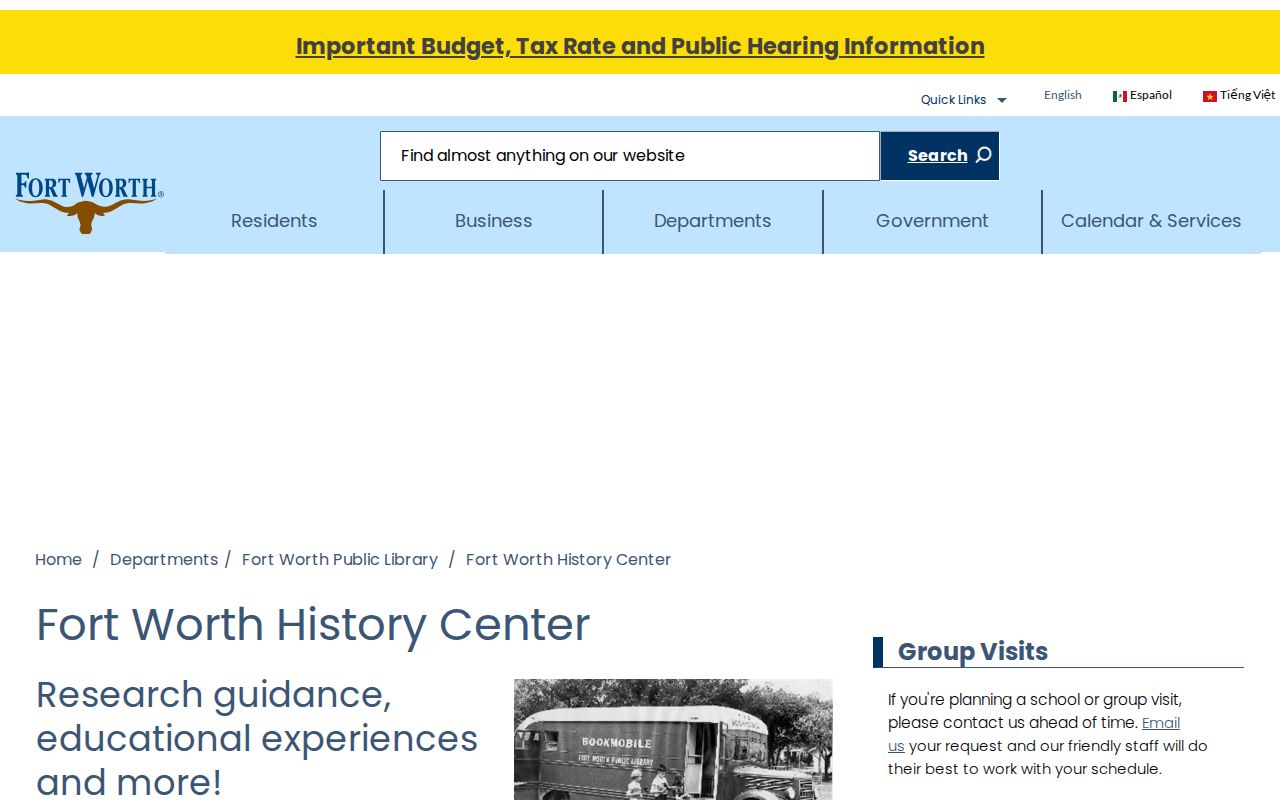
The catalog and offsite-material notice are a reminder to request a particular volume before assuming it is on a shelf.
Fort Worth Library Genealogy, Local History & Archives reports more than 40,000 volumes, about 9,500 microfilm rolls, and 180,000 microfiche. Those holdings include city directories, census material, local newspapers, and licensed databases. The scale explains why a name search can have a useful offline fallback when an online OCR search fails.
Digitized Fort Worth Volumes
The UNT Portal's 1914 Morrison & Fourmy directory is a remote starting point for a specific Fort Worth address or name. It has roughly 790 pages, including individual and business listings, advertisements, and publisher material. UNT also has Fort Worth directory volumes for 1902-03 and 1907-08. OCR speeds up a first pass, but page-image review is necessary because initials, numbers, and old typefaces can be misread.
The digitized 1914 volume captures the kind of page-level source that should be cited with a year and image reference.
Its publisher and extent help distinguish the book from a later index, transcript, or family tree.
The 1907-08 street pages can place entries by street and house number. They may identify a person, business, church, cemetery, vacant space, or a “rear” entry. That makes the volume a historical address tool, but not evidence of present-day occupancy. For a modern parcel-led search, use the Fort Worth street directory records path instead.
Fort Worth Directory Archive Sources
The Tarrant County Archives genealogy holdings add directories to a larger body of marriage, probate, naturalization, school, cemetery, map, and county-government material. The archives are at 200 Taylor Street, Suite 5200. Published walk-in hours are Tuesday through Friday, 9 to 4:30, with Monday visits by appointment. Historic ledger PDFs may be full-text searchable, but handwriting still needs direct page inspection.
The Archives genealogy holdings page identifies companion collections available for a Fort Worth city directory lead.
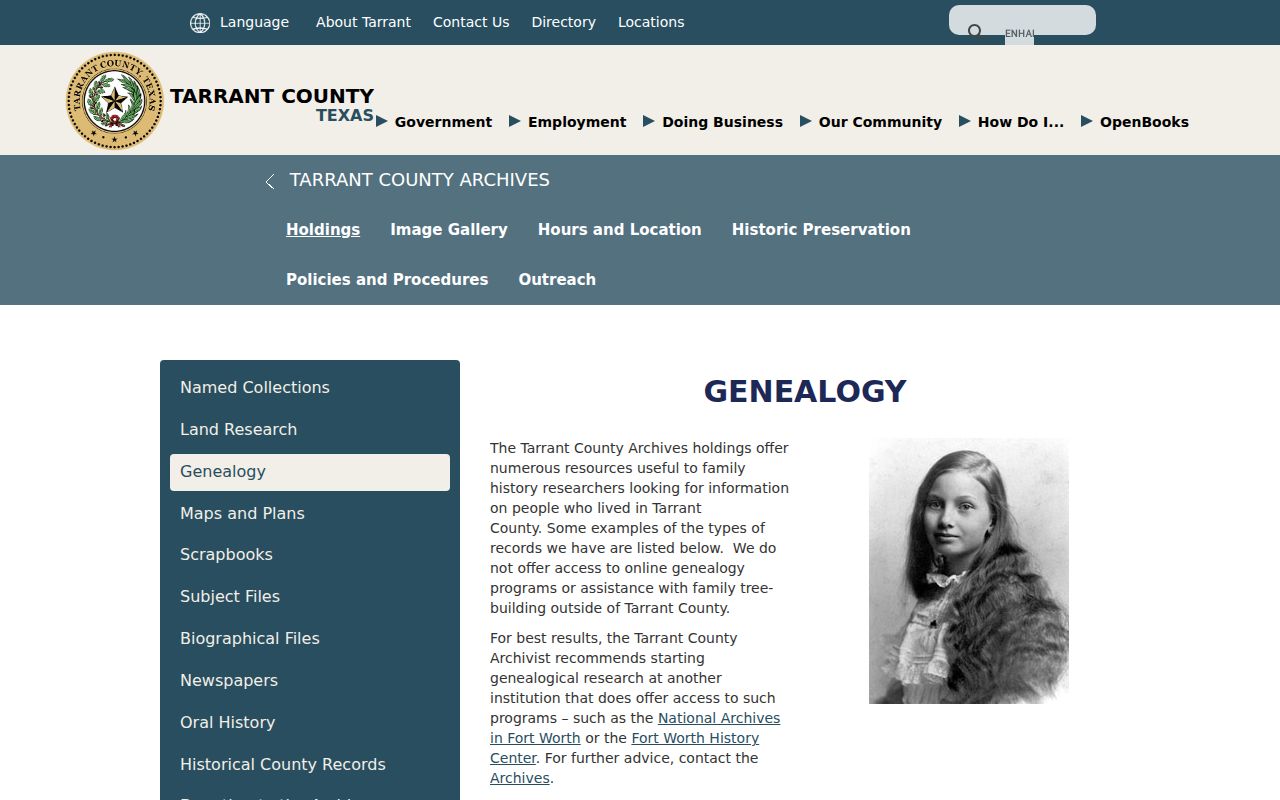
Directory entries become stronger historical evidence when they are matched to a dated ledger, map, probate abstract, or cemetery record from the same repository.
The Tina Walls holdings help fill some later gaps: they include Fort Worth books for 1959, 1961-80, 1985-86, 1988, 1992-2006, and 2008, along with a June 1954 rural directory and a February 1973 telephone directory. The archive's Historical Commission books and the Wagner Kriss Kross volumes can also change a name-first search into an address-first search.
Reading a Fort Worth City Directory Entry
A Fort Worth directory entry should be copied as a compact inventory, not reduced to a bare name. The 1914 volume can identify a name, occupation, employer, residence, telephone, business address, abbreviation, and listing type. The 1902-03 scans show person, occupation, employer, home address, phone, and household markers. Capture the volume year and page image first, then transcribe only what the page supports.
| Entry element | What to record |
|---|---|
| Name | Record initials, alternate spellings, and whether the listing is a person, household, business, institution, or advertisement. |
| Work and address | Copy the occupation or employer and the residence, home, or business address exactly as printed. |
| Telephone and markers | Note a listed telephone, “rear” notation, vacant-space notation, or other address qualifier. |
| Volume evidence | Keep the directory year, publisher, page, image URL, and the abbreviation key used by that volume. |
- Criss-cross directory
- An address-order section that begins with a street and house number rather than a person's name. It is useful for reviewing a historical block.
- Householder index
- A name-oriented finding aid for household entries. It is not proof that every person at an address was recorded.
- Abbreviation key
- The directory's own legend for short forms. The 1902-03 OCR includes “r.” for residence and “h.” for home, so the scanned key should be checked before interpreting a mark.
Historical labels in a directory are source artifacts. Preserve only details needed to identify the record and do not treat old labels as current identity categories.
Tracing Fort Worth City Directory Families
Build a household trail from a strong anchor, such as a full name paired with a year, street, occupation, spouse or parent. Compare years on both sides of a move. The federal census images available for 1850-1950 can add household composition and occupation, but their enumeration date, street label, and ward may differ from the directory. A directory disappearance can mean a move, death, unlisted status, or a gap in the run, not one certain event.
- Find the first plausible name entry and save the exact directory year, page, and image.
- Read the next available volume forward and backward, noting initials, occupation, spouse or parent, address changes, and coverage gaps.
- For a known address, inspect the criss-cross or street-order entries and nearby house numbers rather than relying only on a name index.
- Pair directory years with a census, deed or parcel record, vital index, obituary, church record, or cemetery source.
- Cite the repository and scan, then mark a year as not located when the evidence stops.
Yearbooks, funeral programs, newspapers, churches, cemeteries, and local institutional collections can supply context. The History Center and county archives are better sources for identifying a real collection and access condition than a broad name search. Note: an OCR hit is a lead, while the page image remains the record to verify.
Fort Worth Directory Record Breaks
Fort Worth's historical collections have a sharp early break. Tarrant County was organized in 1850 and Fort Worth incorporated in 1873. The March 29, 1876 courthouse fire destroyed most early county records, though some probate material survived. The verified state-library directory run begins with Fort Worth 1877. A missing earlier deed, civil file, or probate record may reflect that loss rather than a failed search.
- 1873: Fort Worth incorporated, creating a municipal setting for later local records.
- 1876: the courthouse fire destroyed most early county records, creating a major research break.
- 1877: the Texas State Library list begins its verified Fort Worth directory holdings.
- 1902-03, 1907-08, and 1914: digitized Fort Worth directory volumes become available through UNT.
- 1957-58 and later: Wagner Kriss Kross and other address-order volumes extend the historical shelf.
Use a later abstract, re-recorded instrument, newspaper notice, or surviving probate paper as a dated substitute when it is the best available evidence. It should never be described as a complete replacement for a lost original.
Fort Worth City Directory Companions
When a directory year is missing, the local record trail can continue through Early Fort Worth News, the Star-Telegram, county marriage and probate material, school census holdings, naturalization records, cemetery material, maps, and the Fort Worth Digital Archives. The Fort Worth Digital Archives lists municipal and regional collections that include funeral programs, books, photographs, newspapers, and records. Treat an obituary or funeral program as an authored secondary source, then confirm names and dates with a primary record when possible.
Neighborhood names such as Handley, Oakhurst, Riverside, Stop Six, Como, and Northside can help retrieve a dated source, but a name alone is not a boundary or address match. Pair it with the year, street form, and a repository citation.
For an archival request, keep the collection title, creator, date span, box or folder, volume or page, access restriction, and retrieval date. That small citation trail lets another researcher request the same material without repeating a broad search. University repositories, including TCU Library special collections and the University of Texas at Arlington Special Collections, may also hold relevant institutional or community material. Check each catalog before asserting that a specific person's records are held there.