
Fort Worth Previous Residents by Era
A backward Fort Worth address trail starts with the most recent parcel and then uses sources appropriate to the date. Recorded deeds identify transfers and legal descriptions. Directories and census schedules document households, but have gaps and must be tied to a year. Archive ledgers, newspapers, maps, and permits help when one source stops. The table separates the dates that are actually supported from online-coverage claims the County Clerk has not published.
| Source | Years or coverage | Where held | What it can show |
|---|---|---|---|
| Official Records Search | Current official index; earliest online year not stated | Tarrant County Clerk online | Grantor, grantee, subdivision, document type, number, date, and available image trail |
| Historic county ledgers | Land 1897–1908; property 1876–1917 | Tarrant County Archives | Surviving local land and property record leads |
| Fort Worth directories | 1877 onward with documented gaps | State Library list, local library, archives, digitized repositories | Names, addresses, households, occupations, businesses and street context |
| Criss-cross volumes | 1957–58; 1959–96 with 1961–63 missing | Historical Commission and Library of Congress guidance | Address-to-occupant or business lookup by street and number |
| Federal census | 1850–1950 public image range | Federal images and library databases | Time-bound household composition and address context |
| Newspapers and permits | Early Fort Worth News 1873–82; Star-Telegram 1897–present; permit web start not stated | History Center, library databases, City channels | Notices, obituaries, building context, and dated city events |
For a recent previous-resident question, begin with TAD and the recorder index. For an older household question, lead with a directory or criss-cross volume, then use the legal description and deed trail to make sure the old number refers to the same place.
The local access channels matter when an online index stops. The Fort Worth History Center asks researchers to check its catalog before visiting because archives and some items are offsite. It offers local-history and genealogy help by appointment. Tarrant County Archives has more than 600 collections and is open for walk-ins Tuesday through Friday, with Monday access by appointment. A request is stronger when it names the street, approximate number, former owner or occupant, legal description or subdivision, and target dates.
Fort Worth Records After the Courthouse Fire
March 29, 1876 is a real break in the Tarrant County record trail. The courthouse fire destroyed most early county records, though some probate material survived, including charred loose papers. A missing earlier deed, probate file, or civil case can be a historical loss rather than proof that a person had no connection to the address. Later abstracts, re-recorded instruments, newspapers, and ledgers should be labeled as substitute or derivative evidence.
Tarrant County’s historic ledgers collection identifies surviving civil, land, marriage, election, school, naturalization, and property material.
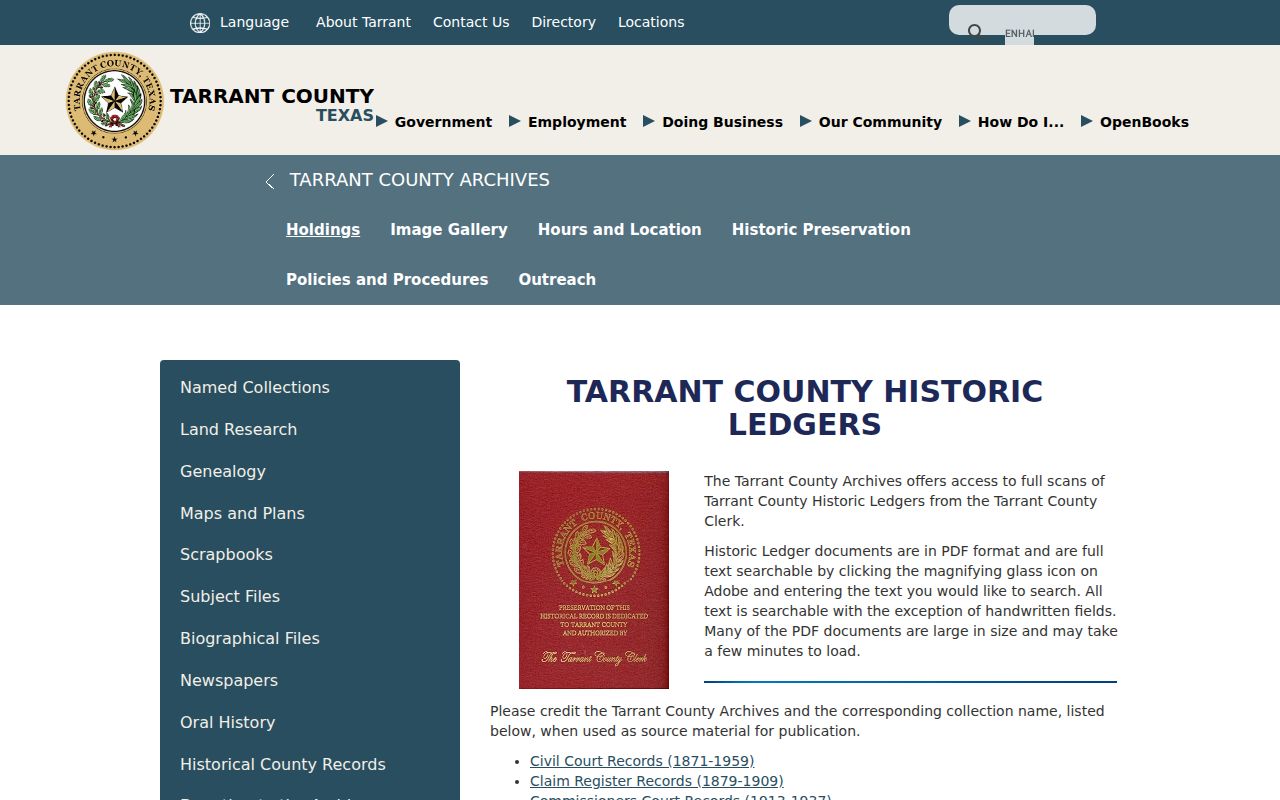
The ledger holdings can bridge an address-history gap, but handwritten entries still require image or page review rather than a keyword-only conclusion.
Trace a Tarrant Deed Chain Backward
Use the Tarrant Appraisal District Property Search to collect the current owner label, property address, account, legal description, subdivision, and instrument. Then use the Tarrant County Official Records Search to locate the recorded transaction. The Quick Search term accepts grantor, grantee, subdivision, document type, or document number, with optional date ranges and index-only or full-text OCR scope. The official accessible page does not state an earliest online year, so do not assume that every older transfer is searchable online.
- Save the current parcel account, situs address, legal description, subdivision, and any instrument shown by TAD.
- Locate the current owner’s purchase instrument in Official Records and record the grantor, grantee, date, document type, number, and legal description.
- Search the seller as a later grantee to find that seller’s earlier purchase, then compare legal descriptions before accepting the link.
- Repeat the transfer sequence one deed at a time. Mark a replat, subdivision change, missing image, or change in street number instead of forcing continuity.
- When the online image trail ends, use the County Clerk’s historic-image conversion route, call Central Library at 817-884-1069, or consult archive and courthouse access channels.
- Grantor
- The person or entity transferring an interest in a recorded instrument.
- Grantee
- The person or entity receiving the interest recorded in that instrument.
- Chain of title
- A dated sequence of recorded transfers for the same parcel, checked one link at a time.
- Legal description
- The lot, block, subdivision, or other parcel description that connects old deeds and plats more reliably than a changing street number.
Fort Worth Previous Residents Need Parcel Continuity
A mailing address can remain familiar while the legal description, instrument, parcel configuration, or owner mailing address changes. That is why past residents should not be linked by house number alone. Compare the lot, block, subdivision, account, and instrument across each transfer. If the description changes after a replat or subdivision, use the plat as the bridge from an old lot and block to the later parcel.
Fort Worth OneAddress, TAD, the county parcel layer, and the Clerk index each carry a different part of that continuity. Permits and code entries add dated address events, but they do not establish title or prove that a named applicant lived at the property. Preserve the result date and source alongside each address form.
Fort Worth Previous Residents in Criss-Cross Volumes
For who lived here before, reverse directories are often the fastest household layer because they run from street and number to an occupant or business entry. Tarrant collections include Wagner Fort Worth Kriss Kross volumes for 1957–58. Library of Congress guidance identifies Fort Worth criss-cross coverage for 1959–96, with 1961–63 missing. A gap is evidence of a missing volume, not evidence that an address was unoccupied.
The Tina Walls collection lists later Fort Worth directory holdings, a 1954 rural directory, and a 1973 Tarrant telephone directory.
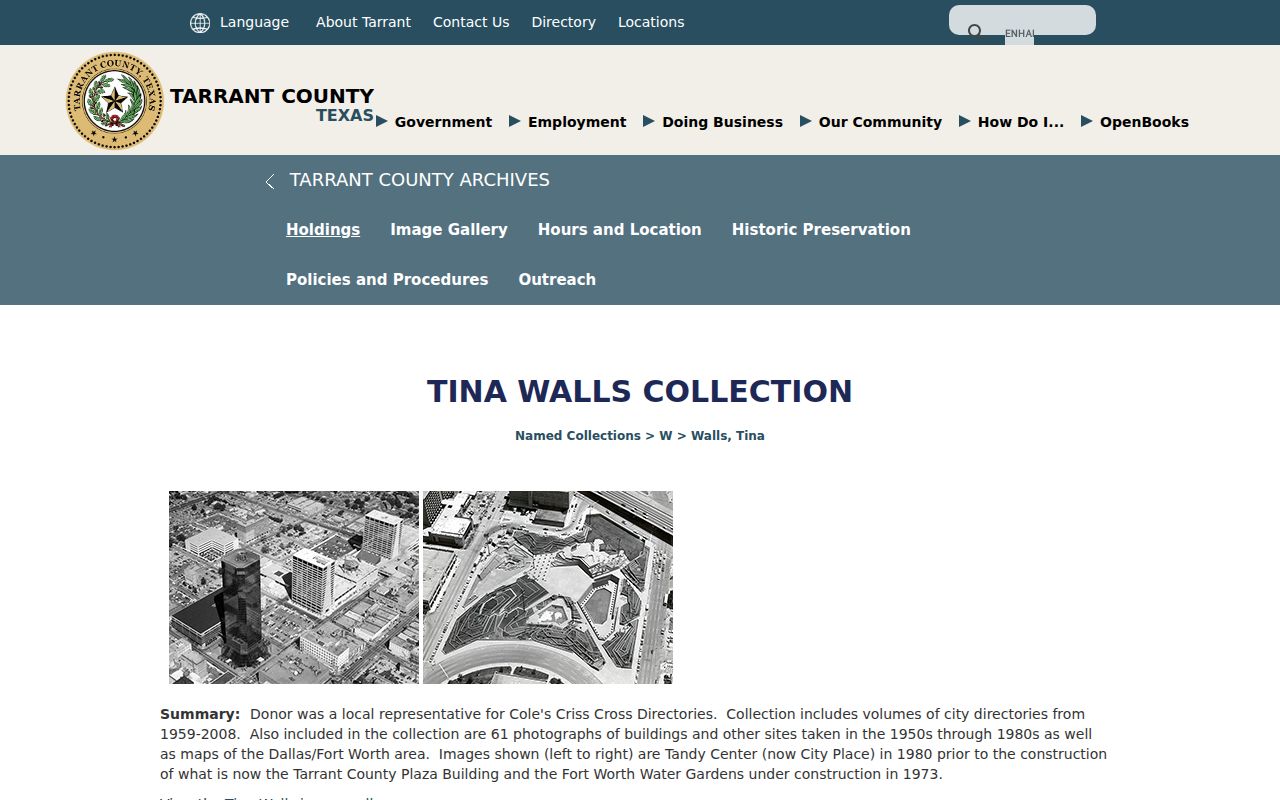
Use the collection list to locate a volume, then check the actual page image and its year before adding any past-resident entry to an address timeline.
The broader repository and volume runs are cataloged on the Fort Worth city directory page, while the address trail remains a separate task.
Fort Worth Past Households and Census
Owners are only one layer of an address history. City directories can list a person, residence marker, occupation, telephone, or business address. The 1907–08 street directory can include a business, church, cemetery, “rear” entry, or vacant notation. Federal census images for 1850–1950 provide a time-bound household record, but enumeration date, street labels, and ward boundaries can differ from the local directory.
- Choose the directory year closest to the address question and copy the street number, name, page, repository, and any printed residence marker.
- Inspect adjacent entries in the criss-cross or street section to catch renumbering, a “rear” entry, a business, or a gap in numbering.
- Find the nearest available census year and compare household names, age, spouse or parent clues, street or ward, and the enumeration date.
- Test the household against a deed, probate abstract, newspaper notice, cemetery record, or local archive finding aid before merging similarly named people.
The Fort Worth History Center has catalog and research support, while archives may be offsite and need advance retrieval. Its newspaper holdings include Early Fort Worth News from 1873 and the Star-Telegram from 1897. Obituaries, funeral programs, and probate material can close a trail after a household leaves the address.
Sanborn maps add a building and lot layer to the household trail. The Library of Congress Fort Worth 1910, Volume 1 material has a 92-image or result versus 88-sheet metadata discrepancy. Preserve the exact image and sheet label used. A Sanborn map can show structures, uses, fire walls, and lot context, but it does not identify every resident or establish title.
Fort Worth Address Numbers Change
Fort Worth’s fire-code addressing materials say the grid radiates from the Tarrant County Courthouse. The Fire Department controls street naming and numbering for safety, while USPS controls city and ZIP designations. When an address changes, USPS can use old and new labels for up to 18 months. Search both versions in directories, TAD, plats, permits, and newspaper archives before declaring the address trail broken.
A parcel annexed into Fort Worth can retain county, school, drainage, or postal labels that do not match the current city name. Try the former subdivision, historical ward or precinct, Tarrant County, Fort Worth, Arlington, and Grapevine where the source and era make that test appropriate.
Note: Keep a dated list of every spelling, directional prefix, suffix, and number variation rather than silently standardizing the address.
Fort Worth Deed Alerts and Record Safety
The County Clerk’s Property Fraud Alert is a current deed-monitoring aid, not evidence of a past resident. It is free, uses an exact name, and sends email or telephone alerts when that name appears as grantor or grantee across more than 90 document types. The County expressly warns that an alert does not prevent fraud and is not a title opinion. Use it to notice a new recording, then inspect the official instrument and parcel record.
The Tarrant County Property Fraud Alert describes the exact-name and notification choices.
The alert can prompt a records check, but it cannot replace a deed-chain review or prove a property’s ownership history.
Limits on Fort Worth Previous Residents
Address history should be written as time-specific evidence. A person shown at an address in a 1914 directory is supported as a historical listing, not as a current fact. Do not merge people with the same surname unless the records share independent anchors such as a time-bounded address, age or event date, spouse or parent, occupation, and a primary identifier. Protected voter addresses, sealed court files, confidential vital records, and redacted instruments remain outside ordinary public-address research.
Lawful personal use. Use Fort Worth past-resident research for house history, genealogy, estates, or civic context. Do not use historical or current records to stalk, harass, track, or harm a living person.
When a record is missing, cite the repository and gap. The Tarrant County Archives walk-in schedule is Tuesday through Friday, with Monday visits by appointment, and the History Center catalog can identify material that needs offsite retrieval.